alauppe

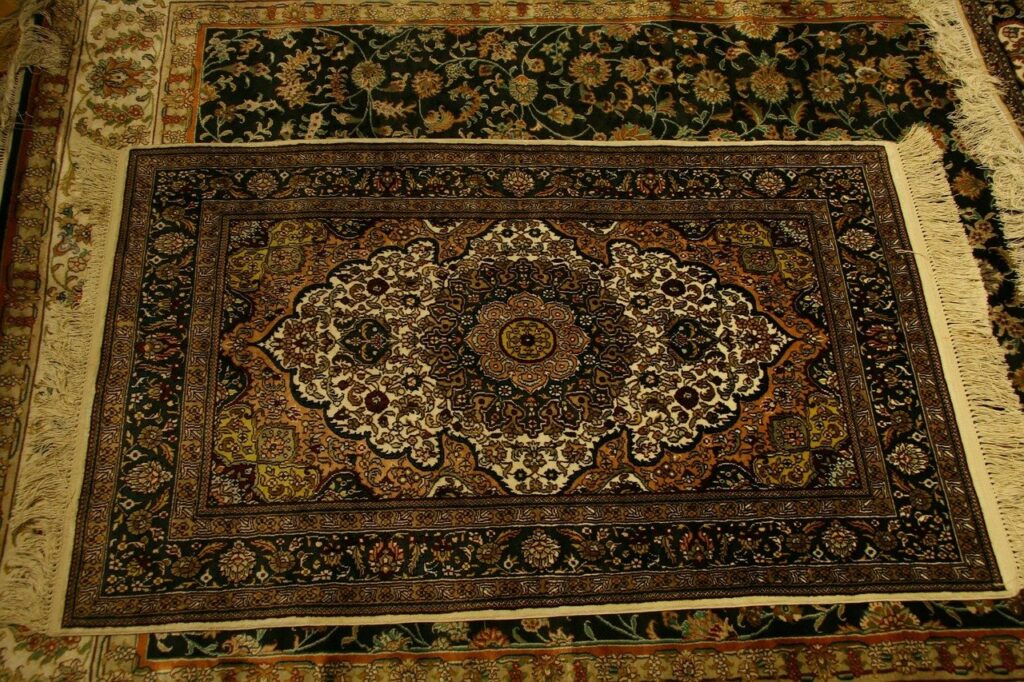
Images shows an antique rug to illustrate the concept of how to identify an antique Persian rug

What To Do with an Inherited Rug

Have you ever inherited furniture, artwork, or a rug? In the past, it was very common for families to pass down household items through generations. Furniture, textiles, and clothing were expensive and time-consuming to produce, so they were carefully preserved and gifted to relatives.

Today, mass production has made many goods more accessible, but the tradition of inheriting meaningful items is still very much alive. With many older generations downsizing and younger people looking for ways to furnish their homes, inherited rugs are becoming more common again. That leaves many people asking an important question: what should you do with an inherited rug?

Determine the Value of the Rug

The first step is to understand what you have. If the rug appears to be antique or potentially valuable, it’s wise to have it professionally appraised, cleaned, and inspected. Knowing the rug’s value, both monetary and historical, will help guide your decision. A high-value rug may be best displayed in a low-traffic area, stored safely, or even sold if it does not fit your lifestyle.

Restore and Repair an Older Rug

Not every inherited rug will be a high-value antique, but that doesn’t mean it lacks potential. Many older rugs show wear over time, but they can often be restored. Some common ways to bring an inherited rug back to life include:

  • Replacing worn or damaged binding
  • Adding new fringe to refresh the edges
  • Cutting down the rug to remove heavily damaged areas
  • Cleaning and repairing worn sections

With the right care, even a well-used rug can become beautiful again.

Incorporate an Inherited Rug into Your Home

Older rugs often feature traditional patterns that may not seem to match modern décor at first glance. However, mixing classic and contemporary styles can create a unique and visually interesting space.

Designing a room around an inherited rug may take some creativity, but it can become a standout feature in your home. Rugs are not limited to floors, either. They can also be used as wall hangings or decorative accents to add warmth and character to a room.

Consider Other Options

If the rug does not suit your taste or needs, you still have options. You might consider:

  • Passing it along to a family member or friend
  • Donating it to a charity, museum, or library
  • Selling it if it has value

What may not work for your space could be perfect for someone else.

Every Rug Has a Story

At Bond Products, we don’t like to think of rugs as disposable. Every rug has a story, whether it’s tied to family history, craftsmanship, or design. Even if it’s not a perfect fit for your home, it may still have value and purpose.

If you need help restoring, repairing, or finishing an inherited rug, Bond Products has the tools and supplies to help. Call 1-888-800-BOND to learn more about how we can help you give your rug a second life.

What To Do with an Inherited Rug Read More »

Images shows an antique rug to illustrate the concept of how to identify an antique Persian rug

How to Identify an Antique Persian Rug

There are many kinds of area rugs people use to decorate their homes and warm their floors, but some of the most treasured are antique, one‑of‑a‑kind works of art woven by master artisans from Persia. These rugs are admired not only for their beauty, but for their history, craftsmanship, and lasting value. What makes an antique Persian rug so special, and how can you tell the difference between one of these works of art and other woven rugs?

What Makes an Antique Persian Rug Valuable?

Several qualities determine the value of a Persian rug. These include the skill of the weaver, the materials used, the age of the rug, its beauty, and its uniqueness. No single factor stands alone. Instead, it is the combination of these elements that gives an antique Persian rug its character and worth.

Any art‑level Persian rug is handwoven by a highly skilled weaver or team of weavers. These artisans spend years developing both technical ability and a strong artistic eye. The weaving process itself is slow and deliberate. A room‑sized rug can take a year or more to complete, with every color, motif, and border carefully chosen to support the overall design. 

When viewing a rug, look at it from multiple angles. Notice how light plays across the colors and patterns, creating movement and depth. A well‑made Persian rug should be pleasing both in small details and as a whole, much like a fine painting.

Materials Matter: Wool and Natural Dyes

Master weavers select only high‑quality materials. The wool in an antique Persian rug should feel soft yet resilient. Not all wool is the same. The environment in which sheep are raised affects both fiber strength and lanolin content. Wool from sheep grazed in regions such as Kurdistan is especially prized for rug weaving.

Natural dyes also add value. Rugs dyed with plant‑based or mineral dyes tend to age more gracefully than those made with synthetic dyes. The colors develop subtle variations over time rather than fading flatly, which adds richness and visual interest to the rug.

Examining the Knots and the Back of the Rug

One of the best ways to identify an authentic handwoven Persian rug is to examine its back. On a handwoven rug, the design appears clearly on both the front and the back. Machine‑woven rugs do not show this level of detail on the reverse side.

Look closely at the knots. A higher knot count usually indicates a more intricate pattern and greater craftsmanship. The type and arrangement of knots can also reveal where the rug was made, since different regions and ethnic groups traditionally use different weaving techniques. Experienced rug and antique experts often identify a rug’s origin simply by studying its knot structure.

Condition and Wear in Antique Persian Rugs

Condition always matters, but some wear is expected in any antique rug. In fact, for very old pieces, wear can even be part of their story. Fewer rugs survive intact from earlier periods, so age and authenticity often outweigh minor signs of use.

That said, the rug should still be enjoyable to live with. It should have been cleaned regularly and protected from damage caused by excessive sunlight, moisture, or mold. These issues can significantly shorten the life of a rug and reduce its value.

Buying Antique Persian Rugs Wisely

If you are considering purchasing a Persian rug, take time to learn about different styles, regions, and periods. Familiarity will help you recognize what appeals to you personally and what represents true quality.

Be cautious of deals that seem too good to be true. Many rugs are marketed as “antique” when they are not. Reputable dealers understand the value of what they sell and price accordingly. Buy what you love, but avoid treating a purchase as an investment unless you are confident in your knowledge of antique Persian rugs.

A beautiful, authentic Persian rug can bring warmth, history, and artistry into a home for generations. Taking the time to understand what makes these rugs special is the first step toward owning one you will truly appreciate.

How to Identify an Antique Persian Rug Read More »

how to layer area rugs

What Causes Rug Creep?

If you have layered your area rugs on any of the carpets in your home, you may have noticed that they tend to travel over time despite being inanimate objects. Have you ever wondered what causes rug creep? Can you do anything to stop rug creep and keep your rugs in place on your carpeted floors?

Why Area Rugs Creep across Carpet

Area rugs can look really beautiful on top of carpet if they are layered with an eye toward design. “Layering your rugs adds depth and scale to a room which not only makes it more interesting, but actually pulls the eyes down and gives your guests additional style elements to enjoy and admire.”

It can be frustrating, though, to put your rugs down in a specific place and watch them slowly creep somewhere else over time. The reason rugs move on carpet is not because they have teeny tiny legs but because the carpet’s pile slants in one direction. All of the fibers in the carpet lean one way so that when a rug is placed on top of that carpet and people walked on it, the rug will slowly be pushed in the direction of the pile by the force of the tread. The carpet remains in place because it is fastened to the floor with staples or nails, but the rug is repositioned every time someone walks across it.

Carpet installers know this. When they install the carpet, they will lay it with the pile towards the main doorway because this will make the colors look more vibrant to anyone entering the room. Similarly, when installing carpet on stairs, the installer will lay it so that the pile flows down the stairs. It will make the carpet last longer and look more attractive. 

When you vacuum carpet, you will notice that it’s easier to vacuum it in one direction than it is in other directions. When you vacuum with the pile, you won’t be meeting resistance from the fibers and it will be an easier job. 

How to Stop Rug Creep

There are many backing products that can be used to stop area rugs from moving. Bond Products offers a number of rug backing supplies including: 

Safety grips – These grips can be peeled and stuck to the back of a rug to keep it from slipping on any surface, including carpet. 

MOVENOT and SUPERMOVENOT rubber backing – Both products can be glued to the underside of a rug. Glue the felt side down to keep it from creeping on carpet and the rubber side down to stop it from slipping on hard floors. 

LOK-LIFT Rug Gripper – This tape can be attached to the bottom of a rug to keep it from moving.

RUGLOCK Spray – This product can be sprayed onto the rug’s back to keep it in place. 

Using one of the above products will keep your area rugs in position and halt rug creep in your home. They are also useful for stopping rugs from slipping across hard floors. If you have any questions about which product would best suit your need, please call us at 1-888-800-BOND. We will be happy to help you choose. 

What Causes Rug Creep? Read More »

humidity

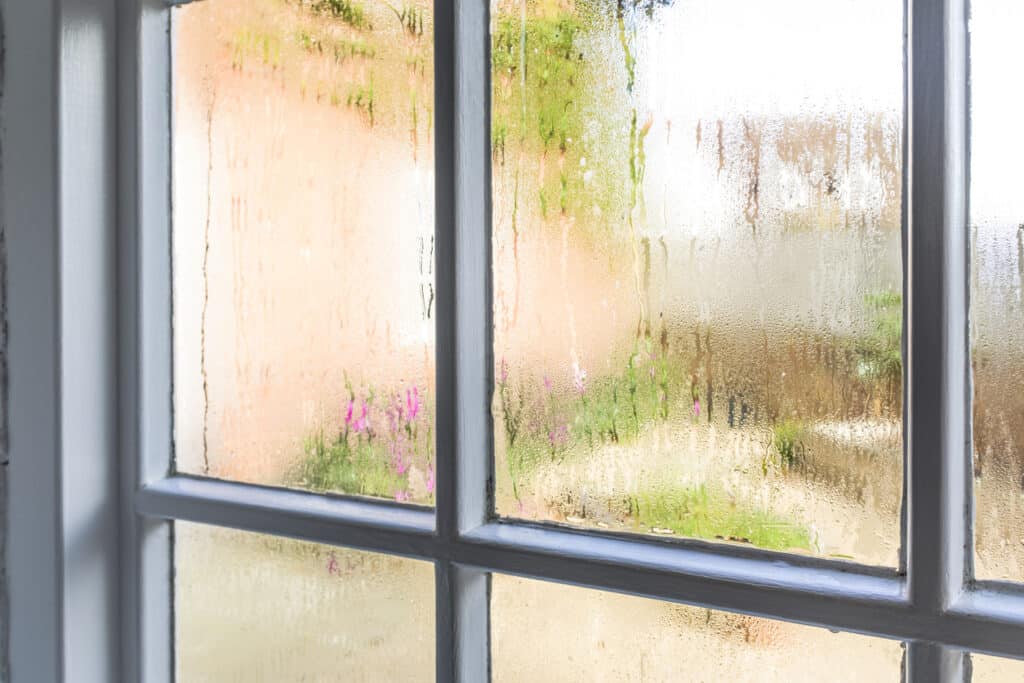
What Effect Does Humidity Have on Carpet?

Changes in the seasons often bring rain and damp. Humidity has a number of damaging effects on carpet that homeowners need to be aware of. How should you care for your rugs and carpets when they’re under more stress?  

First of all, water and dirt go together. When it rains, not just water gets tracked in. Dirt and debris trapped in carpets looks and often smells bad, and moisture will cause mold to grow and weaken the carpet fibers themselves. Additionally, a wetter environment is more welcoming for bacteria and other pests. Insects like fleas need a certain level of humidity for their eggs to hatch, and molds and dust mites proliferate in humid places. If any of your family members struggle with allergies, a humid house will make them worse.

Humidity isn’t just bad for area rugs, over a longer period of time it can cause installed carpets to buckle. If you want your carpets to remain stretched and flat, it’s best to maintain a more consistent temperature and humidity in your house. Both moisture and heat will cause the carpet to swell, and then during winter when it’s cooler and dryer, it will contract. This pulling can loosen installed carpet and result in unattractive rippling.

What can you do to avoid damage to your carpet and rugs?

  • During rainy days set up a humidifier in your house to maintain optimum humidity. Experts estimate that this is between 40-50%. Dryer air inside will allow the carpets themselves to dry more quickly, but stick to the recommended humidity range. If the humidity is too high, your carpets will never completely dry and, therefore, be clean. If it’s too low, your carpets will be dry, but so will your skin and your lungs.
  • During dry days, open the windows and allow the air to flow between the inside and the outside. Getting fresh air in the house is also good for your health and will make everything smell fresher.
  • Keep the temperature in the house within a certain range by setting the thermostat to regulate the furnace and air conditioner when the weather outside fluxuates.
  • Use fans if the humidity gets out of control or if there is a water problem that affects your carpets. It’s what water restoration pros do in emergencies, but you can easily set a fan out yourself if things get damp. Remember, it only takes between 24-48 hours for mold spores to become active.

Water is something everything needs to live, but it can also be incredibly damaging. If you want your carpets to continue to look nice, smell nice, and not shelter mildew or fleas, you need to keep the humidity in your home under control. Don’t let it ruin your carpets and rugs.


What Effect Does Humidity Have on Carpet? Read More »

patio carpet

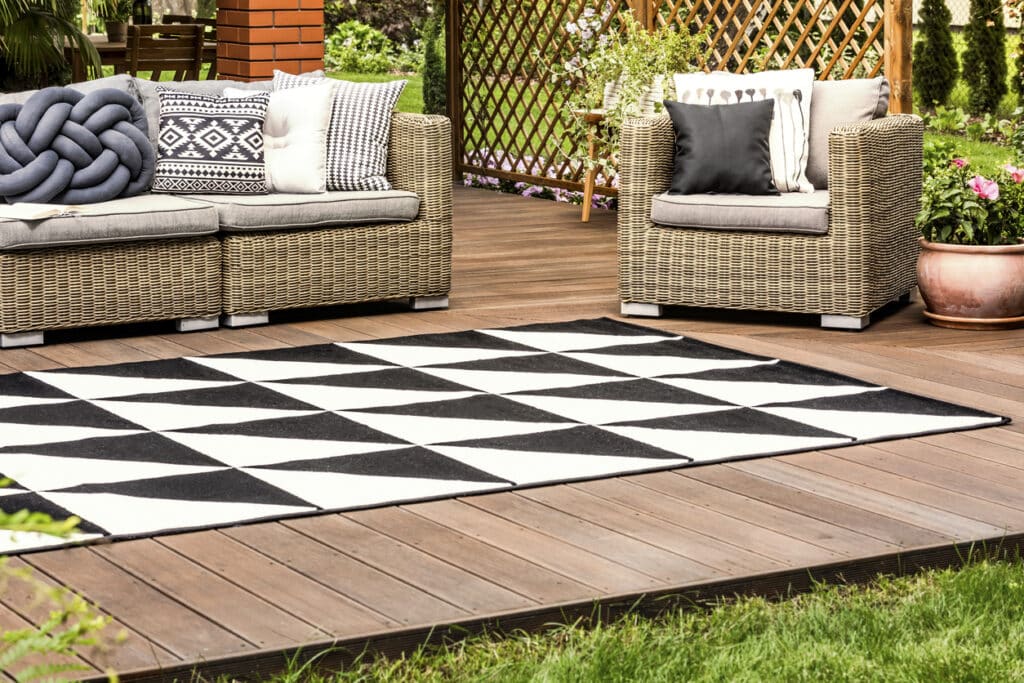
Patio Carpet Choices: Making Your Outdoor Space Cozy

Summer is here again. The days are long, warm, and sunny. After being cooped up in our houses during the COVID-19 lockdowns, most people are ready to be outside as much as they can. Life may be getting more “normal,” but many people are still not ready to spend lots of time in public spaces. For them one solution might be to extend their house outward to the outdoors where it’s easier to be social. If you want to make your porch, patio, or deck more attractive and cozy, what are your options for patio carpet? 

Patio Carpet Challenges

The main enemies of carpet are water, too much sunlight, dirt, and insects. If your outdoor living space is protected from moisture, as a three-season porch is, you can use whatever carpet type you like to decorate. Bear in mind that too much sun exposure will fade carpet, though. If your space will be exposed to all of the above, there are still a number of possibilities for patio carpet or deck carpeting. 

Carpet Options for Outdoors

In terms of aesthetics, it’s hard to improve on carpeting or rugs made of natural materials. They look wonderful outside because the materials they are made from, such as jute or bamboo, naturally belong outdoors. They will blend in beautifully with stone or wood. Their only downside is that they will be more vulnerable to staining, mold growth, and decomposition. You will have to take some care in maintaining them. 

If your space will be used regularly or face tough challenges like high traffic or use by children and pets, opting for indoor/outdoor carpeting or rugs is a good choice. Waterproof carpets are excellent for the pool area or around a hot tub or spa. The plastic fibers in indoor/outdoor carpets are resistant not just to water, but to dirt, fading, stains, and mold. If they get dirty or smelly, they can be cleaned with a mild bleach solution. 

We talked about another solid option for outdoor carpeting in our last blog, and that’s artificial turf. It’s a bit more complicated to install artificial turf than it is to install carpeting and certainly more complicated than to add rugs. Still, for the right location and the right use, artificial turf is a wonderful long-term solution in the home for areas next to decks or patios. 

Adding small rugs to porches or patios is an easy way to make a space pretty and cozy. Smaller rugs can easily be removed if the weather gets too wet. They dry faster in the sun than larger carpets. If you have a carpet remnant, you can always cut out a small piece and bind it with Instabind to make a rug for your space. Our new Instabind colors are all earth tones. They complement a variety of colors and patterns and look good on carpets for the living room or the porch or patio.

For outdoor rugs, we’d also suggest our Outdoor Marine Instabind. It’s especially suited for the wear and tear nature specializes in. The Outdoor Marine Instabind couples well with our Hi-Temp adhesive glue sticks for a tough rug binding that will stand up to heat and moisture. 

Many homeowners have invested time, sweat, and money into their homes this year because they had down time or were stuck at home during quarantines. It was a good time to accomplish a project or finish up one already started. If you’re working on making your porch, patio, or deck a little nicer this summer, don’t forget to add a rug or patio carpet. 


Patio Carpet Choices: Making Your Outdoor Space Cozy Read More »

earth tones

New Instabind Colors Complement the Trend for Earth Tones

During the last few months when many people have had extra down time, lots of them have used it to accomplish home improvement projects. We always encourage our customers to think about binding a piece of carpet to make it an area rug. It’s such a simple and rewarding project. You can use any carpet remnant you like. We have Instabind in a full spectrum of colors, including five new Instabind colors: Heather, Lead, Smoke, Graphite, Chestnut. 

New Instabind Colors

The five newest colors are all earth tones. Lead, Smoke, and Graphite are all variations of gray. Gray is a trending color right now for carpet and interior decorating. It complements both black and white color schemes and also other earth tones. Heather is a shade of tan, and Chestnut is a rich brown color. 

Earth colors are always appealing. People enjoy being in nature because nature helps them to relax and unwind physically and mentally. That’s why incorporating natural earth tones in interior decorating is so pleasing to the eye. Using them mimics the experience of being outdoors. 

Beige is becoming a popular choice as a neutral color and an earth tone too. Behr, the paint and stain company, recently announced its color of the year: Back to Nature. This shade is a light green shade with tan overtones. Behr stated: 

“The living room is the perfect place to prominently feature Back to Nature on the walls. This shade is at once soothing and warm as a welcome alternative to white. Green walls look absolutely amazing in a room with loads of natural light pouring through French doors or large windows. This is the ultimate place to set up a relaxing reading area, complete with a comfy sofa and side chair.”

We believe that this color and other earth tones are great colors for carpets and area rugs as well as walls. It’s easy to add a sisal rug to a hardwood floor. The rug’s natural fibers give the room texture and depth and make it more visually appealing. Wool is another excellent choice of rug material. It’s beautiful, it’s long lasting, and it helps to reduce allergies

How Much Instabind to Order

If you do not know how much Instabind to order for your project, click here for our handy tutorial. It’s very simple to measure your rug or carpet remnant and order the right amount. We also offer Instabind package deals for anyone wanting everything necessary to bind a carpet remnant in one kit. 

If none of the five new Instabind colors appeal to you, we have a wide selection of other colors available. Take a look at your options and then call us at 1-888-800-BOND to place your order for Instabind and any other carpet binding needs you might have. 


New Instabind Colors Complement the Trend for Earth Tones Read More »

DIY projects

Quarantined at Home? It’s Time for DIY Projects

It’s a challenging time for the country and the world. While we’re quarantined, many of us suddenly have time on our hands. Some find that keeping busy with work helps to fight boredom and worry. If you’re wondering just what you’ll do stuck at home over the next days or weeks, now is a good time to work on some DIY projects, the kind you might have wanted to try but didn’t have the time for. 

What Kinds of DIY Projects?

It’s always a great time to make a rug out of a carpet remnant. If your kids are home from school, they can help you with this project because Instabind is very simple to use. All you have to do is cut your rug to size, measure the perimeter, then order the Instabind style and color of your choice, and apply it to the carpet remnant using a glue gun. Instabind is great for updating the interiors of cars, boats, and motorhomes too if yours need some sprucing up before you take them out of storage in a few months. Check out the video:

Another kind of project to tackle would be a more involved Easter craft with your kids. If you’re thinking of dyeing Easter eggs, why not try decorating DIY Easter eggs with hot glue. You can make all sorts of fun patterns using a hot glue gun. Most of our customers use hot glue guns for work, but glue guns are also excellent for crafting. You can use them to make baskets or nests or projects for any school theme your kids are now studying at home. 

It might be a good time to learn a new skill too, like rug carving, rug hooking, or braiding rugs. We have all the supplies you need for making rugs, carving rugs, and then adding non-slip backings to them so they will not slide on your floors and cause accidents. Making a rug really is an art and one that Americans did throughout the history of this country in order to add beauty and comfort to their homes and cabins. It’s the perfect practical, traditional craft. 

For any flooring project involving nails or staples, we have those too. Give us a call at 1-888-800-BOND for any question you might have about our inventory of supplies. We’ll be happy to help you find the right ones. 

A Note on Our Company

Bond Products received an exemption from the State of Pennsylvania and was allowed to re-open as of Monday, March 30, 2020. We had been taking orders over the phone and shipping them, but now we are truly open, although working with a reduced staff. We will ship whatever we have in stock, so if you have DIY, carpet installation, or rug binding needs, please call us, email, fax, or order online, and we will get you stocked up. 

It’s a difficult time for everyone. Please stay healthy and well. God bless you. 


Quarantined at Home? It’s Time for DIY Projects Read More »

retroactive ADD duties

U.S. Commerce Department Announces Preliminary RETROACTIVE ADD Duties

January 3, 2020

Commerce Issues Affirmative Preliminary Determination in the Countervailing Duty Investigation of Imports of Certain Collated Steel Staples from the People’s Republic of China

The Commerce Department has announced preliminary RETROACTIVE ADD duties of 301.64% on ALL Chinese producers and exporters. This will be on top of the CVD duties of 12.38% that were announced and made effective on June 1, 2019. Any company that was sourcing from China will feel the impact. 

Every importer on record will pay this amount retroactive – 301.64% on shipments arriving after 10-1-2019. Shipments from June 1, 2019 moving forward will pay 12.38% (CVB duties).

The following are points a distributor should consider and questions to ask in light of these new retroactive ADD duties:

  • This impacts all staples from 15ga to 19ga shipping from China. This list includes 15ga and 15.5ga hardwood flooring staples, 18ga underlayment/engineering flooring staples,16ga staples “N” wire,and 19ga staples. 
  • What will be my prices moving forward with my supplier?
  • Can my supplier survive a retroactive tariff bill from U.S. Customs? Note: Any retroactive tariff is due to U.S. Customs within 30 days of invoice.
  • Will my current source locate a new supplier without any tariffs? If so, when?
  • The question anyone should ask is: Can I trust a new supplier’s manufacturer’s quality?

Distributors who buy from a non-proven new factory take the risk of passing on poor quality products to their customers, potentially impacting relationships they have built at their expense with their current brand. The other choice is committing to the ProDriveHD® brand. This brand will not be impacted by any tariffs or quality issues. 

Please contact us at Bond Products if you want Superior Quality at the Right Price. Our email is sales@bondproducts.com. We have been in business helping our customers find superior quality products at the right price since 1947, and we continue to do so today. You can place your trust in the products you purchase from Bond.


U.S. Commerce Department Announces Preliminary RETROACTIVE ADD Duties Read More »

difference between a carpet and a rug

What Is the Difference between a Carpet and a Rug?

When people who are decorating their homes or talking about flooring choices, they often discuss carpets and rugs, and sometimes they use these words interchangeably. There is a difference between a carpet and rug, though, and we will go over the history of each and how they are defined today. 

What Are Rugs?

The world’s oldest rug is the Pazyryk rug. Woven of wool in the Turkish knot technique, it’s approximately 2400 years old. Rugs have been a part of human history and decorating a long, long time. The origin of the word “rug,” however, is Scandanavian. The Old Norse word “rogg” meant “shaggy tuft.” It made its way into English in the 16th century, evolving from being used to mean a coverlet or wrap in the 1590s to a mat for the floor by 1808. 

Rugs as they are known now as pieces of woven cloth used as floor coverings are defined as being smaller than carpets, no longer than 6 and a half feet long. If the area of the floor covering is 40 square feet or less, it’s considered to be a rug. Rugs also have bound edges and can easily rolled, picked up, and moved from place to place to be cleaned or placed elsewhere. In home decor, rugs are often grouped with pieces of furniture like beds or couches. 

What Is a Carpet?

Carpets are also pieces of fabric used as floor coverings. The word “carpet” comes from the Old French “carpite” meaning a “heavy decorated cloth” and probably before that from the Latin “carpere” meaning “to pluck” because carpets were made of plucked fabric. It entered the English language in the 13th century meaning a coarse cloth, but by the mid-14th century the meaning had evolved to indicate a tablecloth or bedspread. A century later a carpet began to mean a floor covering as it does today. 

Carpets are larger than rugs, usually being defined as stretching the length of entire rooms or being fixed in place. In some places, carpets are used as wall hangings. In medieval castles tapestries were often hung on walls as decorations and to keep large spaces warmer. Carpets, because of their size or because they are permanently fastened to the floor as with wall-to-wall carpet, are not easy to move or clean. Handmade carpets are also generally thicker than rugs.

Both carpets and rugs come in many styles and patterns and are made from a variety of materials, either natural or synthetic. They range in price from extremely affordable (carpet remnants!) to very pricey. Hand woven, one-of-a-kind carpets like Persian or Aubusson carpets are considered to be works of art.  

What Is the Difference between Carpets and Rugs? 

To sum up:

Rugs are smaller than carpets.

Carpets are more permanent fixtures than rugs. 

Bond Products has everything you need to keep your rugs or carpets maintained and repaired. If you want to bind the rug you made yourself from remnants, we have the products for that. If you want to offer carpet binding as a service to your customers, we have the machines you need. For the staples, staple guns, mallets, mallet caps, L-cleats, or finish nails you need to install carpet, shop our Pro Drive HD™ line of supplies

 Call Bond for all of your rug or carpet related issues large or small. We are here to help! 


What Is the Difference between a Carpet and a Rug? Read More »

carpet serving

What Is Carpet Serging?

When a piece of carpet needs to be finished, there are a number of ways to do this. We’ve talked many times about binding carpets and making rugs from carpet remnants. We’ve also mentioned how to add or replace carpet fringes. Another option is carpet serging. What is carpet serging, and why would you choose to finish a carpet this way?

What Is Carpet Serging?

Carpet serging is a sewing technique where the edges of a carpet are wrapped with thread in order to prevent unraveling and give it a beautiful, finished look. Serging uses a continuous wrap of yarn, about 3/8ths of an inch wide, around the edge of a rug. The yarn is selected to perfectly match or complement the color or colors of the rug. While a carpet can be serged by hand and many antique carpets are finished this way, most serging today is done using a carpet serger because serging by hand is extremely time consuming. Serging looks very similar to a traditional whip stitch except that the yarn is even closer together.

What Is the Difference between Binding and Serging a Carpet?

Binding a carpet involves sewing or gluing a binding tape to the edges of a carpet to give it a finished look. There is no whip stitch used and no yarn. When a rug is bound by machine, the binding tape is sewn on with a straight stitch. This is a much less time consuming process.

For rug owners who like the look of serging but do not want to pay a professional to have it serged or sew the rug themselves, another option Bond Products offers is serging tape. We have two options. One is a 100% cotton tape that is 1 and ¼ inch wide, and the other is 7/8ths of an inch wide. Both are attached to a rug with a binding machine. Both give you the elegant look of serging in far less time and for less money. The 1 and ¼ inch serging tapes come in 60 different colors. Due to the thick quality of this tape, this product comes in 2×36 yard rolls and is sold by the package. It does require a serge tape folder to apply. The 7/8th of an inch tapes are available in 12 colors and comes in 25-yard rolls.

One more choice is Instabind which is available in cotton serge binding style for do-it-yourself serging. It comes in 50 different colors. Standard stock roll sizes are 54 or 216 feet, or you may purchase custom sizes by the foot at a $.40/ft up charge.

Pro tip: If you plan on serging an old rug that has worn or torn edges, you will need to back the entire edge with carpet tape before you serge it. If you do not, the worn edges can tear away from the rug and cause more damage when you attempt to serge it. If your rug is antique or an important heirloom, take it to a professional to restore. 

Serging a rug is a good finishing option if you want a smooth, elegant yarn edge. If you would like to try carpet serging on your rug, check out our inventory of tapes and yarns. If you have questions about what product would be best for your needs, don’t hesitate to call our customer service department at 1-888-800-BOND. 

What Is Carpet Serging? Read More »

road salt

What Does Road Salt Do to Your Area Rugs?

The new year is here, and we are now fully in the winter season. Winter is a great time to tackle some of the homey DIY projects that you might have wanted to do (like replace the binding on a rug or piece of carpet). It’s also challenging in terms of getting around, staying healthy, and keeping the house clean. And when it comes to your area rugs, the season can be brutal. This is because road salt is a rug killer.

Road salt is a life saver, but not for your rugs. Anyone who has driven on snowy highways knows that salt helps keep your car on the road. It melts snow and ice, and it gives tires the traction they need to propel themselves forward. Unfortunately, road salt doesn’t just stay on the road. You can see it everywhere in the winter – on the sidewalks, on the bottom of your car, on your windshield, on your boots, and on the floors in your house.

What Damage Does Road Salt Do?

Road salt leaves unsightly looking stains because of the magnesium and calcium chloride content in the salt. When the water the salt is dissolved in evaporates, it can leave behind a crust. This crust is alkaline. When it remains on fabric long enough it can break down the fibers and even permanently damage them.

What Can You Do to Save Your Rugs?

There are many small things you can do to keep road salt away from your carpets and rugs. These include:

  • Putting down doormats on the inside and outside of any entryway and scraping your shoes on them when you enter the house
  • Taking off your shoes before you enter any living areas of the house and encouraging all family members and guests to do the same
  • Covering your nice carpets with a thick, less valuable winter rug when the weather is really bad
  • Wiping the paws of your pets before they come inside from walking or playing in the snow
  • Sweeping and vacuuming all floor surfaces regularly

If you do track rock salt in the house, don’t panic. You can remove it with this simple cleaning method: Mix equal parts of white vinegar and water and pour it ianto a spray bottle. Spray this mixture on any area with salt. Rub it gently with a brush or cloth to bring the salt to the surface of the rug. Then press a clean cloth into the fibers to soak up the liquid. When the area is dry, vacuum it thoroughly.

If you do find that road salt has damaged one of your rugs or carpets, there are additional steps you can take. You can have your rug cleaned professionally. You can replace any damaged parts like rug fringes, or you can cut out the damaged parts and bind the remaining fabric into a smaller rug. If you need help with any of the replacement parts or binding products for your rugs, call us at Bond Products. That’s what we are here for!  


What Does Road Salt Do to Your Area Rugs? Read More »

artificial turf uses

6 More Artificial Turf Uses

People are most familiar with artificial turf as an easy maintenance ground cover in football fields and soccer stadiums. It’s incredibly useful in sports settings because it doesn’t have to be mowed, reseeded, or fertilized, it won’t cause damage to uniforms, and it’s also softer than actual earth so using it cuts down on injuries for the athletes who play in these arenas. These same qualities make artificial turf useful in so many other situations. Let’s go through some of them.

Playgrounds – The softness of artificial turf is also easier on little behinds than either grass or bark chips, and installing it means that schools, daycares, and parks will see fewer injuries and lessen their liability.

Gyms – What’s good for professional athletes is good for amateurs too. Turf makes for easy footing for runners and competitors and adds a splash of green to indoor environments with no natural light. It’s not just for putting greens and mini-golf courses anymore.

Dog kennels and runs – Cleaning dirt, leaves and grass out of dog fur is not fun, so people who work with pets regularly use artificial turf which is easy to clean and sterilize as well. If you don’t like filling in holes and reseeding the dirt when Fido digs, turf is a good option.

Business landscaping – We’ve already talked about how artificial turf is a new trend in areas of the country that have experienced drought because of the significant savings of water and money. People are installing turf even in places that get adequate rain, though, because it’s so much simpler to care for and always looks nice no matter the weather, the time of year, or the budget of the property owner. You can pay the landscaping company every month or you can pay to have artificial turf installed and spend your money elsewhere.

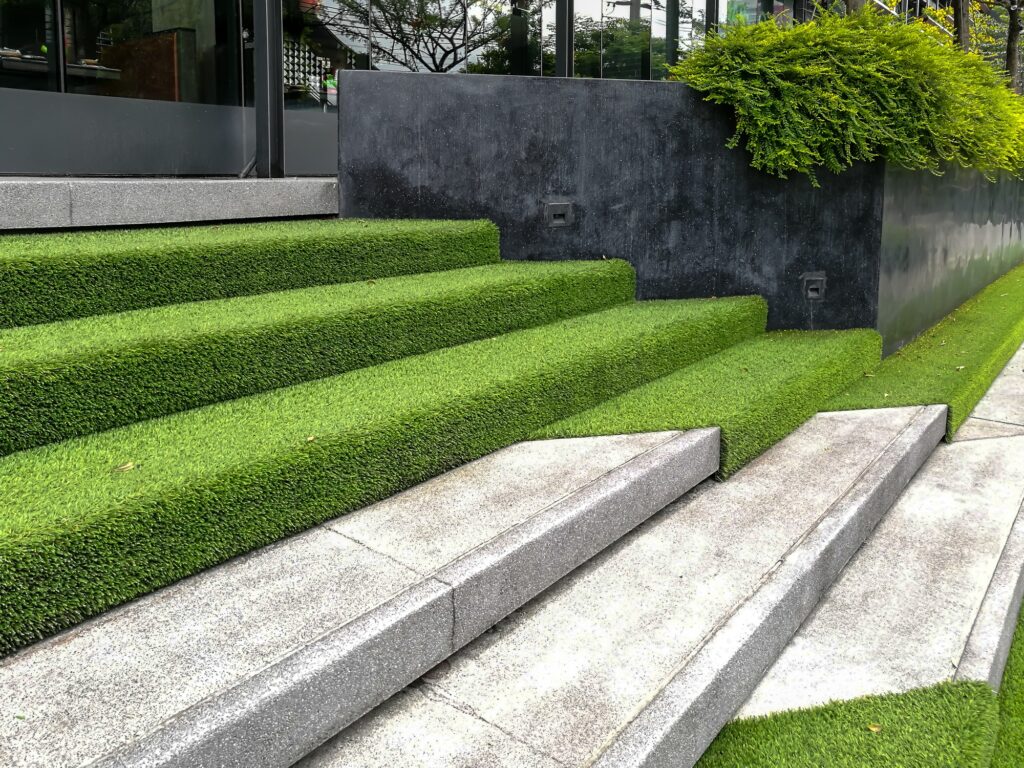
Basements, patios, and balconies – Turf is an excellent indoor/outdoor carpet option as it can be hosed down with water or a bleach/water mix when it gets dirty or mildewed. People in cities who don’t have access to grass but want a green, outdoorsy look are increasingly embracing the use of artificial turf. If you want something softer underfoot, but can’t afford to replace it regularly, artificial turf is an excellent choice.

In your decorating – Do you feel like you’ve run out of ideas for making your home or office different, interesting, and tactile? Embrace turf as an option. Pinterest has its own board for turf ideas. Have you ever considered making a table runner out of turf? Place mats? Pillows? Installing it on walls for a wild, jungle look? The sky’s the limit for this more unusual type of fabric. If you can carpet it, you can turf it. If you can upholster it, you may be able to turf it as well.

Whatever your artificial turf uses, Bond Products has what you need to install it easily in your home or business. If you need staples, staple guns, mallets, mallet caps, L-cleats, or finish nails for your flooring project, shop our Pro Drive HD™ line of suppliesCall us today to stock up on what you’ll need for your turf project to be successful.


6 More Artificial Turf Uses Read More »

area rugs clean

Tips for Keeping Your Area Rugs Clean

After you’ve found a beautiful area rug, and placed it in the perfect spot in your home, you’ll want to make sure you keep it nice so you can enjoy it for many years to come. The best rugs are art, after all, and art deserves to be respected and preserved. So what are some things you can do to maintain your rugs and keep them looking beautiful?

Keep the dirt out of your house

The best way to protect your rugs from the moisture, dirt, and pollen that will cause them to degrade over time is to limit their exposure to these things. Many cultures have the practice of removing shoes at the door so that dirt cannot be tracked in. In some of these countries that habit is entirely pragmatic since they do not have vacuum cleaners. Beating out a rug can be a huge job, but even in places with modern cleaning machinery, it’s best to stop dirt at the door. Put down a mat, and suggest your family and friends place their shoes on it.

If the dirt makes it past the door, however, it’s still not too late. Regular sweeping of your floors will protect your rugs and will help keep pollution and allergens out of your home’s circulating air.

Vacuum

Most of us should be grateful for vacuum cleaners. They make our lives so much easier and cleaner. Are you vacuuming your rugs enough, though? Embedded dirt is worse for your rugs than surface dirt and harder to get out. Make sure you are vacuuming both the front and the reverse sides of your rugs as both get dirty over time, and work at least a weekly vacuuming into your cleaning schedule for best results.

Deep cleaning

Sometimes vacuuming just isn’t enough – you need to deep clean. If you have pets, young children prone to spilling sticky drinks, or have large or ground-in stains, you’ll have to either rent a steamer or call a professional. There is definitely a cost difference between the two, so factor in how valuable your rug is before deciding, but any carpet you want to keep for a long time will have to be deep cleaned every 12-18 months.

Flip your carpet

The traffic patterns of your house will wear a carpet down a certain way, so it’s good to turn the carpet around every 6 months in order to better distribute the wear. Sun can also be another concern. If only a part of a rug is in the sun, the fading will be noticeable over time. Turning it will help minimize fading and keep the whole looking beautiful.

All of the above tips are good things to keep in mind if you have made an investment in your floors. Cleaning and vacuuming more often will also help your home environment to be more healthy and free from the dirt and allergens rugs can trap. Keep yourself, your family, and your rugs in better condition with some easy regular maintenance.

Tips for Keeping Your Area Rugs Clean Read More »

Merry Christmas

Merry Christmas from Bond Products!

As we come to the Christmas season and the end of 2016, it’s natural to look back at what the year held. For Bond Products 2016 was another successful year of creating relationships between great products and great customers. Here are the highlights of new products from our current catalog:

Bond Products now offers 10 new cotton binding and serging tape colors. These additional color options bring the total to 60 tape colors for customers to choose from. Bond Products also has new color card inserts available with 70 colors of ¾ & 1-¼ inch widths of both cotton binding and serging tape (1-¼ inch only). As always, our quality cotton tape is woven, dyed, and finished right here in our family’s fifth generation 100+ year old Philadelphia textile mill. Custom dying is also available to match your color samples, so call for minimums and prices if you would like to extend your options.

We also debuted our PBL-TXB Zig-Zag Tapestry Portable binder which comes with a tapestry guide and your choice of a narrow folder. This machine does the job of three other machines and is equipped with a zig-zag lockstitch that binds ¾ to 3-inch widths of tape in a single pass or a tapestry blind stitch up to 6-½ inches wide. It has a high lift needle for thick rugs, binds over 10 feet of carpet per minute, and is backed by Bond’s 90-day warranty.

Beyond our catalog, it’s been a pleasure to serve both our local and the online carpet community. We opened our doors to people for our 2nd annual Spring Open House in May, offering free labor on portable binder repairs, free instruction and training, trade-in values, and discounts to our customers. We enjoy being able to interact directly with our new and old customers, helping them to get more out of their carpet binders so they can offer more and better services to their own customers.

Every year offers unique opportunities and challenges, and 2016 was no different. Some of us will hold fond memories of it, while others are ready to say goodbye already. But for the year’s final days, we at Bond Products hope you have the best of holidays and will spend time with friends and family and celebrate your traditions and your faith with the freedom our forefathers ensured for all of us. With that, here is our Merry Christmas message to you and yours!


Merry Christmas from Bond Products! Read More »

Close the CTA

All NEW customers use code

WELCOMETOBOND & save 5% today!

Scroll to Top