
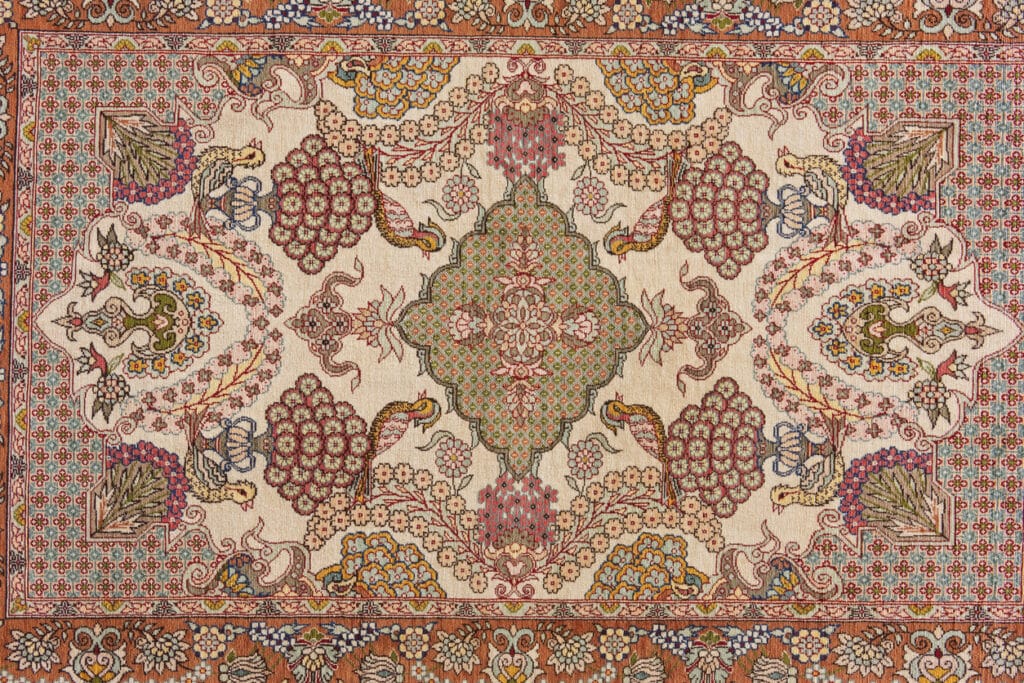
There are many different types of beautiful carpets. We’ve talked previously about practical carpets, craft carpets, and antique rugs, and we’ve explored what makes them different in both use and value. Over time, carpet artisans have refined their craft to the point where rugs are not just functional—they are true works of art. One example of this is the Aubusson carpet. But what exactly is an Aubusson carpet, and why is it considered such a treasure?
Aubusson Carpets and French Nobility
In addition to carpet enthusiasts, readers of history, design, and literature about wealthy households may recognize the name. Aubusson carpets were once the preferred floor coverings of the French nobility and, later, the very wealthy. Before the French Revolution, France operated under a strict social hierarchy where status was defined by privilege. In 1627, the Hospice de la Savonnerie was established by royal order to produce knotted pile carpets for the kings and queens of France. These carpets were used in royal residences and often given as diplomatic gifts.
The Origins of Aubusson Weaving
Naturally, carpets reserved for royalty became highly prized. Members of the French nobility wanted similar quality for their own homes, which led to the establishment of workshops in the villages of Aubusson and Felletin. Aubusson was already known for its detailed pictorial tapestries, often depicting landscapes or hunting scenes. These were woven as wall hangings and displayed as fine art in elite residences.
The region’s weaving tradition has a long and complex history. Some legends trace its origins to the Saracens who remained in the area after the Battle of Tours. Later, skilled Huguenot weavers settled in Aubusson while fleeing religious persecution. Many of them were eventually forced into exile after the revocation of the Edict of Nantes. As a result, the carpet trade in France rose and fell depending on political and religious conditions at the time.
What Makes an Aubusson Carpet Unique?
Many Aubusson carpets were created using a pileless tapestry technique, which is why the term “Aubusson carpet” often refers to flatwoven rugs. However, some pile carpets were also produced. Early designs were influenced by Oriental rugs, but over time the style evolved. Weavers began incorporating more floral patterns, scrolling vines, and architectural motifs, similar to those seen in Savonnerie carpets.
Aubusson Carpets Today
Today, the Aubusson style continues to influence rug production around the world. Weavers in countries such as India, Pakistan, and China produce rugs inspired by this classic European design. These rugs often feature the same elegant floral and architectural elements rooted in the Renaissance period. Unlike many other handwoven styles, Aubusson carpets reflect a distinctly French artistic tradition.
Caring for an Aubusson Carpet
If you own an Aubusson carpet, you have more than just a floor covering. You have a piece of history and a work of art. With proper care, it can remain a beautiful and valuable part of your home for years to come.
