When most people think about glue guns, they picture craft projects or small home repairs. But glue guns have become essential tools in modern manufacturing and daily life. They offer safety, accuracy, and convenience, improvements that dramatically changed how glue is applied across industries.
What Is Glue Made Of?
Before glue guns, adhesives came from very different sources. More than a hundred years ago, glue was often made from the leftover parts of butchered animals, like hooves, bones, skin, and tendons. Boiling these tissues released collagen, a naturally sticky protein used to make animal glue. That’s where the phrase “fit for the glue factory” came from.
Animal-based glues worked, but they had serious drawbacks. They were water soluble, meaning they often broke down in heat or humidity. Other glues came from tree resins, especially from conifers, but those also had limitations.
These types of glue required heating to high temperatures and were applied with brushes. The process was messy, imprecise, and dangerous. Factory workers frequently burned themselves, and the glue took a long time to dry. Imagine trying to install Instabind using a pot of boiling glue and a brush—that was the reality before glue guns.
The Invention of Thermoplastic Adhesives
The turning point came in the 1940s when Paul Cope developed a thermoplastic adhesive for Procter & Gamble. Shortly after, George Schultz saw injured workers at a shoe factory and realized a better delivery method was needed. He invented the first glue stick gun, known as the Polygun. He then launched the Industrial Shoe Machinery Company. By 1973, 3M had purchased the company and helped popularize glue stick guns for industrial and consumer use.
How Does a Glue Gun Work?
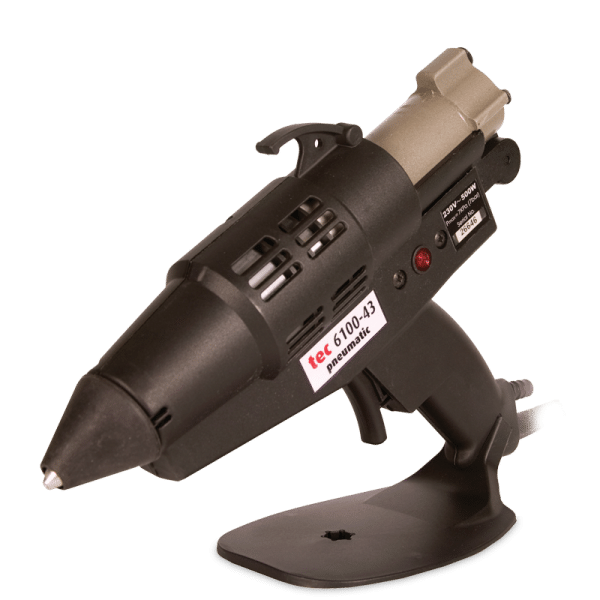
Glue guns use thermoplastic adhesive sticks. These glue sticks are fed into the back of the gun, where they’re melted and dispensed through a nozzle. The hot glue spreads easily, then cools quickly to form a solid bond.
Unlike water-based glues, thermoplastic adhesives don’t dissolve in humidity. They create a strong, long-lasting hold and dry in seconds. Glue guns also protect your hands. With no need for brushes, fingers are much less likely to touch hot glue during application.
Why Glue Guns Are Better
The advantages of glue guns are hard to ignore:
- Speed: The glue sets quickly, saving time.
- Precision: You can apply glue in a clean, straight line.
- Durability: Thermoplastics form tough, moisture-resistant bonds.
- Safety: The gun design keeps glue and fingers separate.
These improvements make glue guns indispensable in industries ranging from carpet installation to electronics, woodworking, and crafts.
Glue Guns at Bond Products
At Bond Products, we carry a wide range of glue guns for both professional carpet work and home DIY use. Whether you’re securing binding, working with Instabind, or assembling something more creative, a good glue gun is a must-have tool. Explore our glue and glue gun selection to find the right tool for your needs.
